Renewable ethanol from food waste
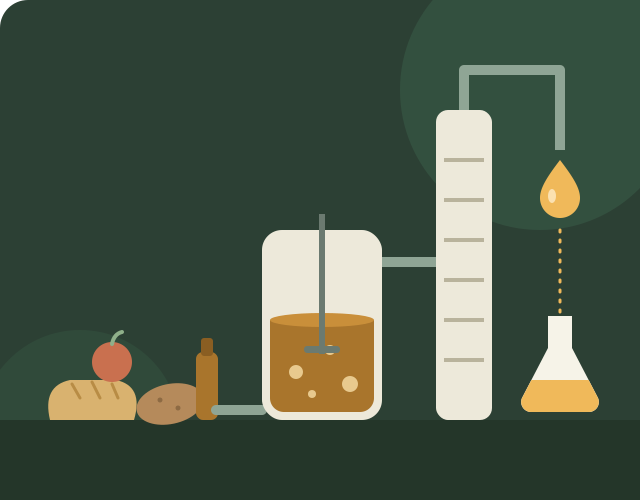
Food waste in.
Fuel-grade ethanol out.
IGNIS is an automotive-grade ethanol made from heterogeneous food and agro-industrial waste, lowering feedstock cost without taking crops grown for food off the table.
See how it worksGet in touchBuilt by Newcycl Clean Technologies Pvt. Ltd.
The problem
A fuel market this big shouldn't depend on the food supply
India now blends about 20% ethanol into petrol, and demand runs to roughly 1,200 crore litres a year. Almost all of it is still grown, not recovered.

Demand is enormous and still rising
E20 blending was reached ahead of India's 2030 target, and the volume of ethanol needed keeps climbing.
It runs on crops
About 74% of ethanol comes from maize, sugarcane and grain. Prices swing with weather — sugar rose from ₹48.18 to ₹55.70/kg — and poultry feed gets tighter and costlier.
Usable carbohydrates get landfilled
Bakery, potato, beverage and fruit-processing residues are hauled to landfill, where they produce methane and leachate and their energy is lost.
What the feedstock costs
Ethanol procurement price per litre (₹). Food-waste figure is a published research estimate.
Maize feedstock alone works out to ~₹63 per litre of ethanol, before any processing.
Ethanol share in petrol
Average blending, by year
The gap isn't whether food-waste ethanol is possible — it is. It's whether it can be made at commercial yield and consistent cost from real, messy waste. That is what IGNIS is built to do.
Our approach
An engineered route from waste to ethanol
We target concentrated, relatively clean carbohydrate-rich residue from food processors — not indiscriminate mixed municipal waste — and build the process around its variability.

Onsite at large generators
A plant beside a bakery, potato processor or beverage unit producing 10+ tonnes of waste a day — cleaner feedstock, no collection network.
Cluster plants in food parks
Where waste is spread across many smaller units, one plant aggregates compatible residues from the whole zone.
Select & blend
Group waste by carbohydrate profile for predictable input.
Sort & dewater
Preprocess only as far as the feedstock needs.
Pretreat
Release fermentable sugars from starches at low cost.
Ferment
Adapted microbes convert sugars to ethanol at high solids.
Recover
Separate ethanol from the fermentation broth.
Purify
Distil to fuel-grade IGNIS ethanol.
Nothing is wasted twice: residual organic matter after ethanol recovery goes on to biogas or composting.
Lower feedstock cost
Waste is a near-zero or even negative-cost input, against ~₹63/L for maize feedstock alone.
No food-versus-fuel trade-off
Every litre made from waste is a litre not drawn from crops people and livestock need.
Less landfill, less methane
Diverts carbohydrate-rich waste from disposal and recovers its energy as fuel.
The science
Biology engineered for real-world waste
Fermenting clean sugar is easy. Real food waste is variable, wet and full of inhibitors that stall standard yeast. IGNIS combines three research-backed levers to handle it.
Adapted yeast strains
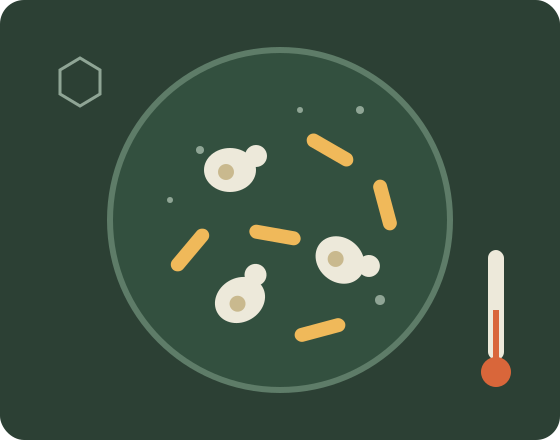
Laboratory-evolved, thermotolerant Kluyveromyces marxianus has shown ~80% higher fermentation efficiency at 42°C under inhibitor stress, with a 56% shorter lag phase.
Adaptive laboratory evolution, ~60 generationsThermophilic bacteria
One-pot routes such as the CRUDE method ferment untreated food waste directly using heat-loving anaerobes — no pretreatment or added enzymes.
Conversion of Raw and Untreated Disposal into EthanolHigh-solids process
Less water and fewer enzymes per litre of ethanol — the two cost lines that usually sink waste-to-ethanol economics.
Process design targetEngineered consortia & blending
Strain selection paired with feedstock blending, tuned to the inhibitor load and sugar profile of Indian food-processing waste.
Our R&D focusFigures refer to published peer-reviewed studies on adaptive laboratory evolution of inhibitor-tolerant yeast and on simultaneous hydrolysis and fermentation of food waste. Results from published research are indicative of the approach, not IGNIS performance guarantees.
Contact us
Let's build this together
We're keen to hear from funders, incubators and accelerators, food processors with carbohydrate-rich residues, and research collaborators.
The team building IGNIS
Anu Khandelwal
Founder & CEO, NewcyclMSc Business Analytics, University of Edinburgh, with 7+ years in data, technology and product development. Awarded ₹71 lakh in grants from DST, MeitY, MoHUA, IIT Kanpur, BITS Pilani, SIDBI and others; featured in The New York Times, YourStory, Red FM and Amar Ujala.
Darpan Gupta
Technical Co-Founder · Founder, Ripe Life SciencesIIT Delhi Silver Medalist, B.Tech–M.Tech in Biochemical Sciences. Deep expertise in microbial systems, fermentation, strain optimization and bioprocess development; named inventor on a US patent application for a bioprocess purification method.